Purchasing and formulation teams searching for beef liver powder in bulk are usually past the “should we launch a liver SKU” stage. The questions now are commercial: what a wholesale spec sheet should actually say, whether a “desiccated” listing is the same material as a freeze-dried one, what really moves the beef liver wholesale price per kg, and who can ship a drum from US stock without a production-run minimum. This guide is written for supplement brands, contract manufacturers and pet-nutrition formulators buying drums, not retail pouches.
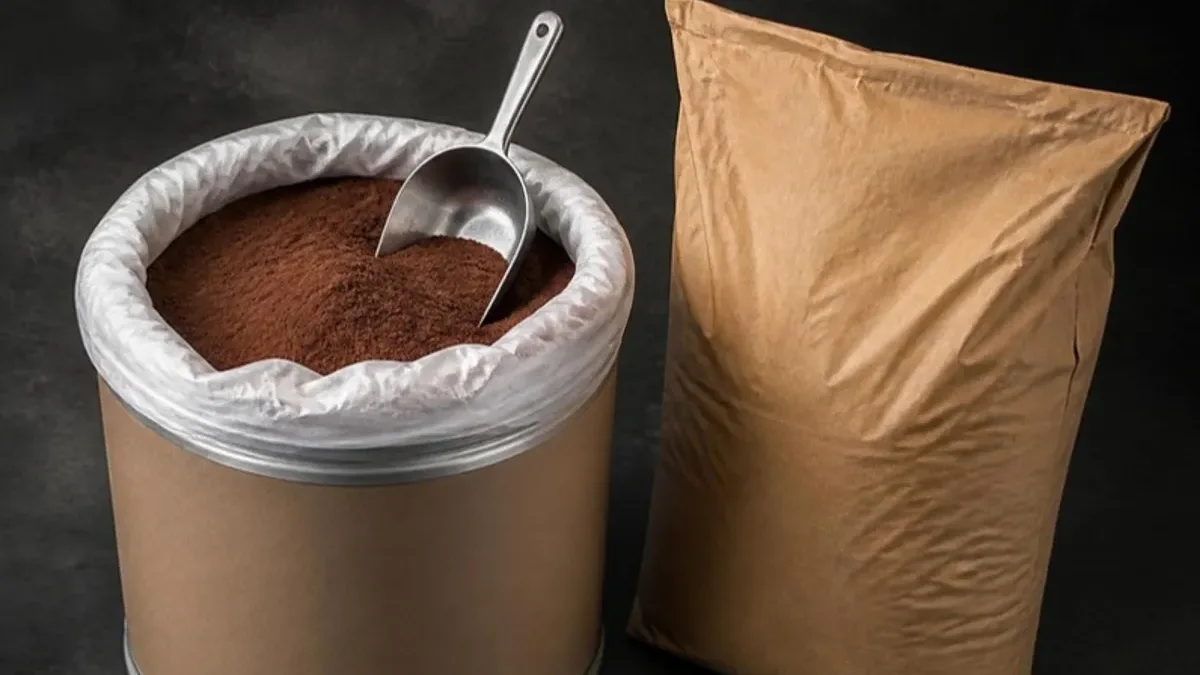
Zenith Nutra Products stocks grass-fed beef liver powder (freeze-dried) from New Zealand cattle with a 25 kg MOQ, packed in 25 kg fibre drums with a double food-grade PE liner, and typical dispatch in 3–7 business days from US stock in Ronkonkoma, Long Island, New York. 1 kg and 5 kg foil pouches are available for sampling. Zenith does not publish list prices; request a quote with quantity, ship-to ZIP and any spec changes.
“Desiccated” vs freeze-dried: read the drying method, not the adjective
“Desiccated beef liver” simply means dried beef liver. The word does not tell you how it was dried, and drying method is one of the biggest differences between two bulk lots that share a product name. Low-temperature freeze-drying, spray drying and drum drying all produce a “desiccated” powder, at very different cost and with different colour, odour and processing history.
- Ask for the method and the temperature in writing. Zenith’s published specification is freeze-dried below 45°C.
- Ask whether it is defatted. Zenith’s liver powder is undefatted; defatted material flows better and keeps longer but is a different product, and the choice must match your label copy.
- Check colour on the sample. Zenith’s pages describe correctly freeze-dried liver powder as deep reddish brown; grey or near-black powder has usually been heat-dried.
Use “desiccated” on your own label if that is the term your customers search for — but specify the drying method on the purchase order so the word cannot hide a cheaper process. For the full provenance checklist (grass-fed for life vs grain-finished, BSE/TSE status, facility traceability), see what to verify before you buy grass-fed beef organ powder.
Reading a bulk beef liver powder spec sheet, line by line
A wholesale specification is only useful if every line can be checked against a lot Certificate of Analysis (COA). The table shows the lines buyers should expect, what to ask about each, and Zenith’s published values. Values are typical; the COA issued for your lot governs.
| Spec line | What to ask the supplier | Zenith published value (ZNP-OR-001) |
|---|---|---|
| Source and origin | Country on the COA, not just in an email; grass-fed for life or grain-finished; can the processing facility be named? | Bovine liver, grass-fed and pasture-raised; New Zealand (Australia available on request); traceable to the processing facility |
| Drying method | Freeze, spray or drum dried — and at what temperature? | Freeze-dried below 45°C |
| Defatted? | Defatted or undefatted, and does it match your label copy? | No — undefatted |
| Protein | Method and whether reported per lot | ≥ 70% |
| Moisture | Limit at release; storage conditions to hold it (freeze-dried organ powders are hygroscopic) | ≤ 5.0% |
| Particle size | Limit and sieve; does it suit your encapsulator or tablet press? | 100% through 80 mesh |
| Microbiology | Lot-specific results for the full panel, not a generic spec | TPC ≤ 10,000 cfu/g; yeast & mould ≤ 100 cfu/g; E. coli absent; Salmonella absent in 25 g; S. aureus absent |
| Hormones and antibiotics | Written statement for the lot | None administered |
| BSE/TSE | Statement referencing the origin country’s official risk status | Negligible-risk country statement supplied |
| Heavy metals | Ask for results on the lot COA itself and state any limits your QA requires | Request on the quote (numeric limits are not listed on the product page) |
| Shelf life | Sealed shelf life and retest date on the COA | 24 months sealed |
Red flags on any quote: “desiccated” with no drying method; origin given as a region or “imported”; a catalogue PDF offered in place of a lot COA; microbiology reported as “typical” only; no BSE/TSE statement; a lot number that does not match the drum label.
Bulk beef organ powders and MOQs at a glance
Many buyers order liver alongside other organs, either to build their own ratio or to buy a ready-made complex. Zenith’s published bulk line:
| Product | Published MOQ | Origin | Bulk packaging |
|---|---|---|---|
| Grass-fed beef liver powder | 25 kg | New Zealand (Australia on request) | 25 kg fibre drums, double PE liner; 1 kg / 5 kg sampling pouches |
| Grass-fed beef heart powder | 25 kg | New Zealand (Australia on request) | 25 kg fibre drums, double PE liner; 1 kg / 5 kg sampling pouches |
| Grass-fed beef kidney powder | 25 kg | New Zealand (Australia on request) | 25 kg fibre drums, double PE liner; 1 kg / 5 kg sampling pouches |
| Grass-fed beef spleen powder | 25 kg | New Zealand (Australia on request) | 25 kg fibre drums, double PE liner; 1 kg / 5 kg sampling pouches |
| Beef organ complex blend (5-organ) | 25 kg standard ratio; 100 kg for custom ratios | New Zealand (blended in the United States) | 25 kg fibre drums, double PE liner |
All five list a typical lead time of 3–7 business days from US stock, with FOB and DDP terms and domestic LTL or parcel shipping from Ronkonkoma, NY. For context, publicly listed minimums in this category range widely — from small stock lots to production runs of several hundred pounds or more, and marketplace listings that quote 25–100 kg or more from overseas factories (observed in public listings, October 2026; confirm with each supplier). A 25 kg drum from East Coast stock lets you validate a lot on your own line before committing to volume.
What drives beef liver powder wholesale price per kg
Zenith does not publish list prices, and per-kg prices quoted online vary so widely that they are rarely comparable. These are the variables that actually explain the spread between two quotes for “grass-fed beef liver powder”:
- Origin and herd programme. Named-country, grass-fed-for-life supply with facility traceability costs more than unspecified or grain-finished material.
- Drying method. Low-temperature freeze-drying is a slower, more energy-intensive process than spray or drum drying, and it is priced accordingly.
- Defatted vs undefatted. The processing route changes yield and handling; make sure both quotes describe the same material.
- Milling and mesh. A finer or custom mesh adds processing. Zenith’s standard is 100% through 80 mesh; other meshes are specifiable on request.
- Testing and documents per lot. A lot COA with a full microbiological panel, BSE/TSE statement and traceability records costs more to produce than a generic spec sheet. Extra assays your label requires (for example a specific nutrient figure) add cost; ask for them on the RFQ.
- Order size and pack. Single drum, multi-drum or pallet quantities price differently; sampling pouches carry a higher per-kg cost than drums.
- Stock location and freight. Duty, ocean freight and port time sit inside an imported landed price. Material already held in Ronkonkoma ships domestically, so compare delivered cost to your dock, not ex-works numbers.
- Certificates. A Halal option is listed for Zenith’s organ powders; Kosher and Halal certificates are supplied where applicable. Only claim them on pack if the certificate covers your lot.
Compare quotes on cost per kg delivered — and per 1,000 capsules
For capsule products, translate every quote into the number your finance team cares about. Zenith’s product page puts a size 00 capsule at roughly 500–600 mg of freeze-dried liver powder depending on tamping, so one kilogram fills approximately 1,700 to 2,000 capsules. A 25 kg drum is therefore in the region of 42,500–50,000 size 00 capsules of powder (estimate; your fill weight governs).
- Delivered cost per kg = (powder price + freight + duty or brokerage, if any) ÷ kg received.
- Powder cost per 1,000 capsules ≈ delivered cost per kg ÷ 1.7–2.0 at size 00 (estimate).
- Then add shell, filling, bottle and label cost — or ask for finished goods instead (below).
For fill weights by capsule size, see the capsule size chart; for shell choice with hygroscopic organ powders, see gelatin vs HPMC capsules for wholesale buyers.
From sample pouch to drum to finished goods
- Sample: 1 kg or 5 kg foil pouch to check colour, flow and fill on your equipment. Zenith states that a quote request returns pricing, a current COA and a sample within two business days.
- First order: 25 kg drum per organ powder, typically dispatched in 3–7 business days from Ronkonkoma.
- Custom ratio: blended to your percentages from 100 kg, with homogeneity verified by multi-point assay and a sample before the full batch.
- Finished capsules under your brand: Zenith’s contract manufacturing programme starts at 3,000 units for capsules, with production under cGMP (21 CFR Part 111) in an FDA-registered facility through its certified partner network. See private label beef organ capsules for the fill math and MOQ at each stage.
Documents to request with every lot
- Lot-specific Certificate of Analysis (with country of origin and processing facility)
- Safety Data Sheet (SDS)
- Technical and specification sheet
- Allergen, GMO and gluten statements
- BSE/TSE negligible-risk country statement
- Kosher and Halal certificates where applicable
- Full lot traceability records
RFQ checklist for bulk beef liver powder
- Organ(s) and quantity: 25 kg drums, number of drums, or custom blend ratio (100 kg+).
- Origin requirement: New Zealand, or Australia on request; grass-fed for life.
- Drying method and maximum temperature; defatted or undefatted.
- Mesh/particle-size limit if different from 100% through 80 mesh.
- Microbiological limits and any extra assays your label or customer requires (heavy metals, nutrient figures).
- Documents needed before PO and with each lot (list above).
- Ship-to ZIP, FOB or DDP, and the date the material must be on your dock.
- Whether you want powder only, or a quote for finished private-label capsules as well.
Related products and reading
- Grass-Fed Beef Liver Powder (Freeze-Dried) — full specification and documents
- Beef Organ Complex Blend (5-Organ) — standard and custom ratios
- What to verify before you buy grass-fed beef organ powder
- Private label beef organ capsules — sourcing, fill math and MOQs
- Contract manufacturing RFQ checklist for US supplement brands
Ready to compare a drum against your current supplier? Request a quote with organ, quantity and ship-to ZIP. You will get pricing, a current Certificate of Analysis and a sample from Ronkonkoma, NY stock.