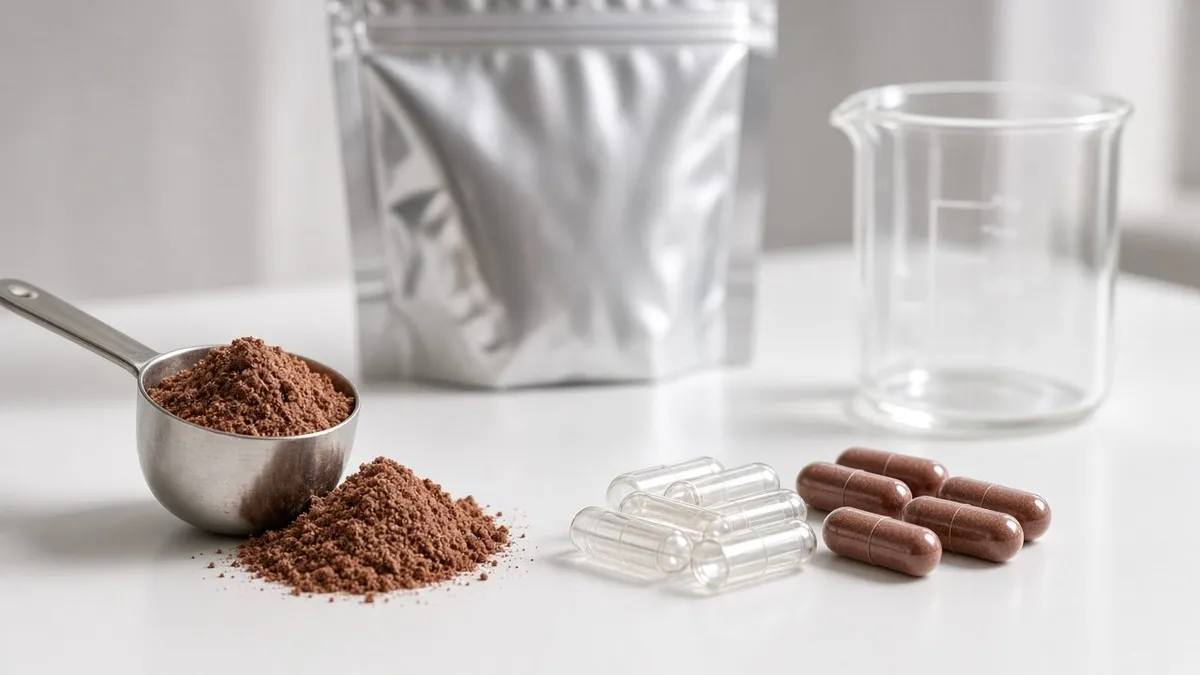
Brands searching for a beef organ supplement white label or private label beef organ capsules programme usually face the same four decisions: which organs go in the bottle, what documents prove the raw material is what the label says, which capsule shell and size to run, and what minimum order applies at each stage. This guide walks through each decision for US supplement brands, using only the specifications, MOQs and lead times published on Zenith Nutra Products pages. Zenith holds grass-fed beef organ powders, empty capsules and packaging as US stock in Ronkonkoma, Long Island, New York, and manages finished private-label production through its contract manufacturing programme.
Values quoted below are typical. The Certificate of Analysis (COA) issued for your lot governs. Zenith does not publish list prices — request a quote for current pricing at your volume.
Three routes to a private-label beef organ supplement
Before comparing organs or shells, decide how much of the production chain you want to own. The route sets your MOQ, your timeline and who signs the batch record.
| Route | What you buy from Zenith | Published minimum | Published timing |
|---|---|---|---|
| 1. Bulk powder to your own encapsulator | Freeze-dried organ powder in 25 kg fibre drums (plus empty capsules if needed) | 25 kg per organ powder; empty capsules from 1 carton | 3–7 business days from US stock |
| 2. Private label (existing validated formula) | Finished, labelled capsules from Zenith's catalogue of organ complexes, under your artwork | Contract manufacturing from 3,000 units for capsules (confirm on quote) | Typically 4–6 weeks from purchase order to palletised finished goods |
| 3. Custom formulation | Your own organ ratio or added actives, developed and produced under contract | 3,000 units for capsules; custom organ ratios from 100 kg of blend | First bench sample 10–15 working days from a written brief; production 4–6 weeks from artwork approval |
Route 2 is the fastest path to a sellable product because the formula already has stability data on file. Route 1 suits brands that already have an encapsulation partner. Route 3 suits brands that want a liver-heavy or non-standard ratio. Contract manufacturing runs under cGMP (21 CFR Part 111) in an FDA-registered facility through Zenith's certified partner network.
Single beef liver or a five-organ complex?
Most private-label launches start with one of two SKUs: a single-ingredient beef liver capsule or a multi-organ "complex". Zenith publishes both as ready-to-encapsulate powders:
| Attribute | Grass-Fed Beef Liver Powder (ZNP-OR-001) | Beef Organ Complex Blend (ZNP-OR-005) |
|---|---|---|
| Composition | Bovine liver, grass-fed and pasture-raised | Liver, heart, kidney, spleen, pancreas (liver-forward standard ratio) |
| Origin | New Zealand (Australia available on request) | New Zealand (blended in the United States) |
| Drying | Freeze-dried below 45°C; undefatted | Freeze-dried below 45°C |
| Protein (typical) | ≥ 70% | ≥ 68% |
| Moisture / mesh | ≤ 5.0%; 100% through 80 mesh | ≤ 5.0%; 100% through 80 mesh |
| Blend control | Single ingredient | Homogeneity verified by multi-point assay |
| MOQ | 25 kg | 25 kg standard ratio; 100 kg for custom ratios |
| Shelf life | 24 months sealed | 24 months sealed |
Single liver is the simplest label (one ingredient, one COA) and the easiest fill to validate. A five-organ complex is the format most ancestral-nutrition brands sell, but blending it yourself is where small manufacturers run into trouble: five powders of differing bulk density and particle size do not mix evenly without proper equipment, and an uneven blend produces capsules that do not match the label. That is why the Zenith complex is blended under cGMP and assayed at multiple sample points in every batch.
If you want to set your own ratio, single-organ powders are also stocked at a 25 kg MOQ, including grass-fed beef heart powder, beef kidney powder and beef spleen powder. Zenith can also blend to your percentages from 100 kg and sample against them before the full batch. (Pancreas is supplied within the complex; a standalone pancreas SKU is not currently listed.)
Raw-material documents to request before you approve a lot
Ancestral products sell on provenance, so provenance is what your QA team must verify. For each organ powder lot, Zenith's published document pack includes:
- Lot-specific Certificate of Analysis — Zenith states its COAs show identity, assay, heavy metals and microbiological results. Ask for the heavy-metal results on the COA itself; numeric heavy-metal limits are not published on the organ product pages.
- Country of origin and processing facility — named on the lot documents, with full lot traceability records.
- BSE/TSE statement — referencing New Zealand's negligible-risk status.
- Full microbiological panel — for liver, typical limits are total plate count ≤ 10,000 cfu/g, yeast and mould ≤ 100 cfu/g, E. coli absent, Salmonella absent in 25 g and S. aureus absent.
- SDS, technical/specification sheet, allergen, GMO and gluten statements.
- Kosher and Halal certificates where applicable — a Halal option is listed for the organ powders; only claim it on pack if the certificate covers your lot.
Also confirm in writing whether the animals were grass-fed for life (not grain-finished), whether the powder is freeze-dried or heat-dried, and whether it is defatted. Our seven-question beef organ powder sourcing checklist covers each point in detail.
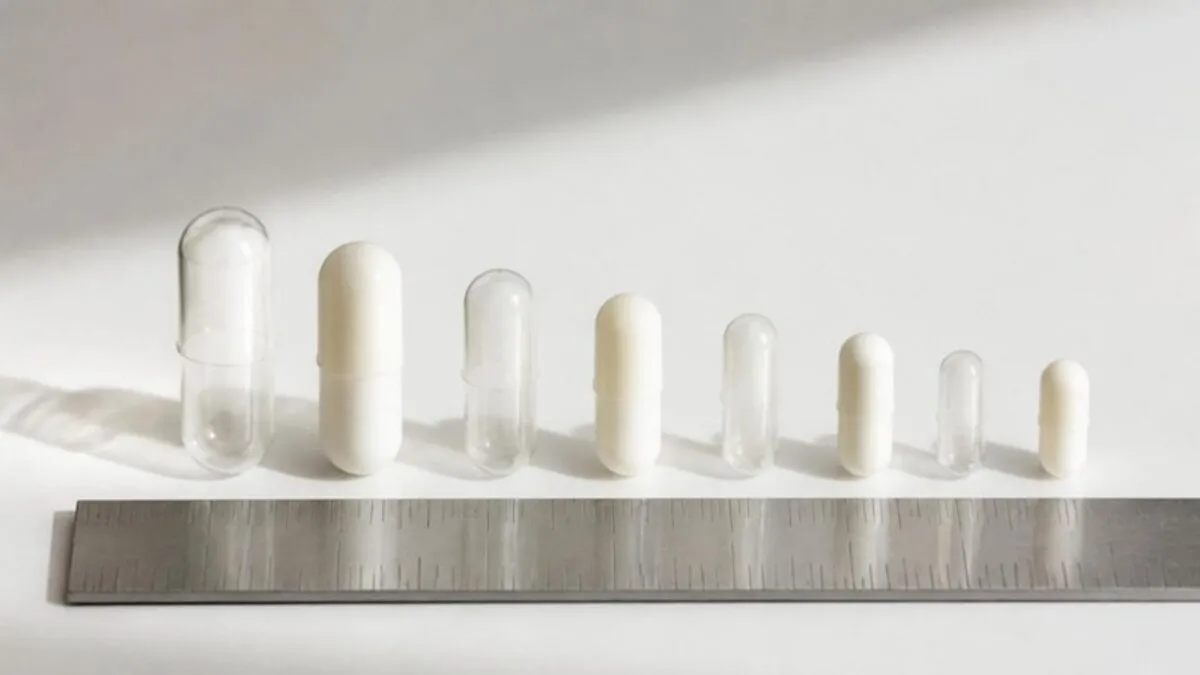
Capsule shell: bovine gelatin or HPMC, size 00 or 0
Zenith's empty capsules are stocked in bovine gelatin, porcine gelatin and vegetarian HPMC, clear, coloured, opaque or printed, and ship loose or are drawn straight into a Zenith contract manufacturing run so that shell and fill release against one batch record.
- Bovine gelatin — runs faster on most filling machines and costs less. Typical moisture 13–16%. Request the BSE/TSE statement for the shell as well as the powder.
- HPMC — typical moisture 4–9%, which tolerates hygroscopic fills better. Freeze-dried organ powders are hygroscopic, so HPMC is worth trialling if your stability or storage conditions are demanding. Also useful when your positioning excludes gelatin.
- Size 00 — the most common supplement size and the usual choice for organ capsules. Size 0 — a smaller capsule at a lower fill weight per capsule.
- Printed or custom-coloured shells carry a higher minimum and a longer lead time than stock clear shells, so raise them at project start.
For finished goods, Zenith's contract manufacturing lists capsules in bottles in sizes 00–3, gelatin or HPMC, induction sealed and labelled. For a deeper comparison, see how to choose empty capsules.
Approximate capsule fill math: capsules per kilogram
Fill weight decides how many capsules a kilogram of powder fills, and therefore how many drums your first run needs. Use this formula, then confirm with a fill trial on your actual lot:
Capsules per kg ≈ 1,000,000 mg ÷ fill weight per capsule (mg), and fill weight ≈ capsule volume (mL) × tapped bulk density of the powder (g/mL) × 1,000.
| Shell size | Approximate fill (freeze-dried liver) | Approximate capsules per kg | Basis |
|---|---|---|---|
| 00 | ~500–600 mg | ~1,700–2,000 | Published on Zenith's beef liver product page ("depending on tamping") |
| 0 | ~375–450 mg (estimate) | ~2,200–2,650 (estimate) | Derived: commonly published shell volumes of about 0.91 mL (size 00) and 0.68 mL (size 0) imply a liver tapped density of roughly 0.55–0.66 g/mL; 0.68 mL × 0.55–0.66 g/mL ≈ 375–450 mg |
These are approximations, not specifications. Bulk density varies by lot and tamping, and the five-organ blend's density is not published, so measure it from your sample lot. Confirm shell volume with the shell lot spec.
Worked example (packaging example, not a dose recommendation): 3,000 bottles × 180 size-00 capsules = 540,000 capsules. At 500–600 mg per capsule that is roughly 270–324 kg of powder, or about 11–13 drums of 25 kg, before your manufacturer's process loss and overage. A 90-count bottle at the same quantity needs roughly 135–162 kg. Ask your contract manufacturer for its overage figure in writing.
MOQs and lead times at each stage
| Stage | Published minimum | Published timing |
|---|---|---|
| Evaluation sample | 100 g to 1 kg, charged at cost and credited against a first order | Pricing, current COA and sample within two business days of enquiry |
| Organ powder (liver, heart, kidney, spleen, standard complex) | 25 kg (1 kg and 5 kg foil pouches available for sampling on single organs) | 3–7 business days from Ronkonkoma, NY stock |
| Custom organ ratio blend | 100 kg | Made-to-order; confirm on quote (Zenith publishes 3–5 weeks for made-to-order) |
| Empty capsules (stock clear) | 1 carton (count varies by size) | 3–7 business days from US stock |
| Finished private-label capsules | 3,000 units | Typically 4–6 weeks from artwork approval |
Bulk powder blends produced as finished goods under the contract manufacturing programme are published from 500 kg; confirm which programme your blend falls under when you request a quote. Shipping is FOB or DDP, by domestic LTL or parcel from Ronkonkoma, with international air and sea freight available.
Label and claims cautions
A private-label organ capsule is a dietary supplement, so the label is regulated even when the ingredient is a whole food. Keep the launch clean:
- No disease claims. Do not state or imply that the product treats, cures, prevents or mitigates any condition, on the label, the website or Amazon listings.
- Structure/function statements need substantiation, an FDA notification and the standard disclaimer. Have qualified regulatory counsel review any such copy before print.
- Sourcing claims must match the documents. "Grass-fed", "New Zealand", "freeze-dried", "undefatted", "Halal" or "Kosher" should appear only where the lot COA and certificates support them. "Grass-fed" is not a protected term in every market, so define it.
- Declare the shell. Bovine gelatin and HPMC read differently to shoppers, and the shell choice affects religious and dietary positioning.
Under Zenith's private-label route, your artwork receives a regulatory review against FDA labelling rules before print. That review supports, but does not replace, your own regulatory sign-off.
RFQ checklist for a private-label beef organ capsule
Send these points with your enquiry to get a usable first quote:
- Route: bulk powder only, private label from an existing formula, or custom formulation
- Organ(s) and ratio (single liver, standard 5-organ complex, or your percentages)
- Origin requirement (New Zealand, or Australia on request) and any grass-fed-for-life wording
- Shell material (bovine gelatin or HPMC), size (00 or 0), colour or print
- Target fill weight, capsules per bottle and bottles per SKU
- Bottle, closure, induction seal and label format
- Quantities in units and kilograms, plus forecast for reorders
- Documents required at PO (COA, SDS, spec sheet, allergen/GMO, BSE/TSE, Kosher/Halal)
- Ship-to location, target date and FOB or DDP terms
For the full list of contract terms to lock in writing, use our contract manufacturing RFQ checklist for US supplement brands.
Why East Coast brands start the conversation in Ronkonkoma
Production calendars slip when actives or shells are listed as "US stock" without a city. Zenith holds the organ powders, the empty capsules and the packaging conversation in one place in Ronkonkoma, Long Island, New York. Brands in New York, New Jersey, Pennsylvania and New England can sample powder within days, validate a fill, then move the same specification into a private-label run without changing suppliers mid-project.
Next step: send your organ choice, capsule size, bottle count and quantity through the request-a-quote form, or review the private label manufacturing programme. You will receive pricing, a current lot COA and a sample within two business days.
Related products and reading
- Grass-fed beef liver powder (freeze-dried), 25 kg MOQ
- Beef organ complex blend, 5-organ
- Grass-fed beef heart powder
- Empty capsules, gelatin and HPMC, sizes 000–4
- What to verify before you buy grass-fed beef organ powder
- How to choose empty capsules
- Contract manufacturing RFQ checklist (US)
- Private label manufacturing
- Request a quote