Formulators and purchasing teams searching for a capsule size chart usually need one practical answer: which shell size (000 through 4) will hold the target dose at the blend’s real bulk density — before bottles, labels and filling change-parts are ordered. This Insight is written for B2B buyers comparing wholesale empty capsules, not DIY retail. It uses only fill-weight ranges Zenith publishes on its empty capsules product page for sizes 00 and 0, labels every other capacity figure as an industry-typical estimate, and steers East Coast buyers toward named Ronkonkoma stock, a 1-carton MOQ and the document pack that clears QA.
Values shown as Zenith programme facts come from the live empty-capsules product page. Industry-typical volumes and fill estimates for other sizes are drawn from widely published hard-capsule charts (supplier technical literature) and are not Zenith specifications. Always confirm size with a fill trial on your lot; the lot Certificate of Analysis (COA) and the shell drawing for the grade you buy govern.
How capsule numbering works (000 is largest)
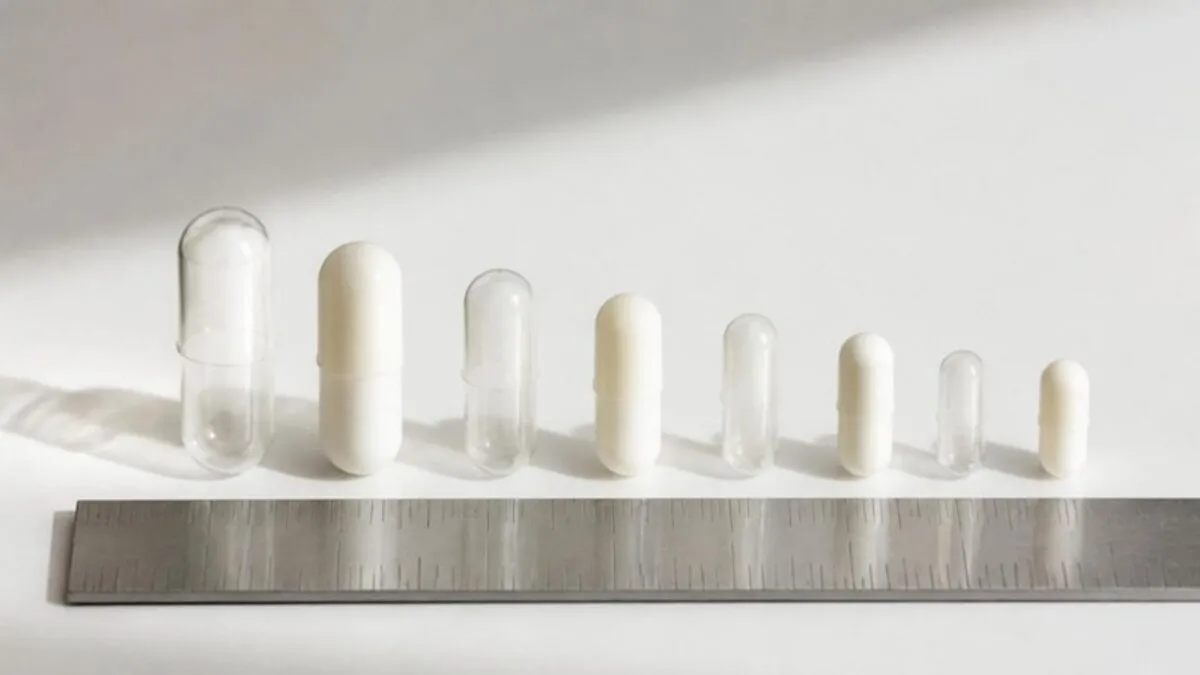
Hard two-piece capsules are numbered in reverse of everyday intuition: 000 is the largest common human size Zenith lists, then 00, 0, 1, 2, 3 and 4 is the smallest on Zenith’s published empty-capsule programme. Size 00 (“double zero”) is the most common supplement shell; size 0 is the next most common when the dose and density fit a smaller capsule. Numbers alone do not equal milligrams — fill weight is roughly internal volume × tapped bulk density of the powder, and tamping on an automatic filler changes the result.
Size range note (do not invent which is “correct”): Zenith’s empty-capsules product page and East Coast stock Insight list sizes 000, 00, 0, 1, 2, 3 and 4. Zenith’s contract-manufacturing empty-capsule supply page currently lists sizes 00 to 4 (no 000 on that page). Confirm size 000 availability on the quote if your programme needs it.
Capsule size chart 000–4 (buyer view)
Use the table to shortlist a size, then lock the choice with measured density and a machine trial. Zenith-published fill ranges appear only for sizes 00 and 0. Other fill columns are industry-typical estimates at example densities — useful for RFQ planning, not as a purchase specification.
| Size | Industry-typical volume (mL) estimate | Zenith-published fill weight (density-dependent) | Industry-typical fill at ~0.8 g/mL estimate | Common B2B use |
|---|---|---|---|---|
| 000 | ~1.37 mL (estimate) | Not published as a Zenith numeric range | ~1,100 mg (estimate) | High-dose or bulky botanical blends when one capsule is required |
| 00 | ~0.90–0.95 mL (estimate) | ≈ 570–1100 mg (Zenith product FAQ) | ~720–760 mg (estimate; overlaps Zenith range) | Most common supplement size; default starting point for many fills |
| 0 | ~0.68 mL (estimate) | ≈ 400–800 mg (Zenith product FAQ) | ~540–550 mg (estimate; overlaps Zenith range) | Mid-dose programmes; often preferred when swallowability or bottle count matters |
| 1 | ~0.48–0.50 mL (estimate) | Not published as a Zenith numeric range | ~380–400 mg (estimate) | Lower fill weights; specialty actives |
| 2 | ~0.36–0.37 mL (estimate) | Not published as a Zenith numeric range | ~290–300 mg (estimate) | Low-fill formulas |
| 3 | ~0.27–0.30 mL (estimate) | Not published as a Zenith numeric range | ~215–240 mg (estimate) | Low-dose / precision fills |
| 4 | ~0.20–0.21 mL (estimate) | Not published as a Zenith numeric range | ~160–170 mg (estimate) | Very low fill; dosing precision dominates |
Industry-typical volumes and non-Zenith fill estimates above are approximate and vary slightly by shell manufacturer drawing. They are not Zenith COA values. Zenith does not publish per-size carton piece counts — carton count varies by size and is confirmed on the quote.
Size 00 vs size 0 capsule — the decision most POs turn on
Buyer queries for size 00 vs size 0 capsule and capsule sizes 0 00 000 dominate autocomplete around this topic. Practically:
- Size 00 is larger than size 0 in length, diameter and nominal volume. Industry charts typically put 00 near ~0.90–0.95 mL and 0 near ~0.68 mL — roughly one-third more nominal volume in the 00 (estimate; confirm on the shell drawing).
- Zenith’s published guide ranges: size 00 ≈ 570–1100 mg; size 0 ≈ 400–800 mg, both density-dependent. Send target dose and bulk density; Zenith will confirm size before you commit to bottles and labels.
- Choose 00 when the blend is bulky, the dose is high, or you want fewer capsules per serving.
- Choose 0 when density packs the dose into the smaller shell, or when the brand wants a smaller physical capsule.
- Do not freeze artwork until a fill trial on the production lot (or a representative sample lot) confirms fill weight and lock quality. Changing size after printed shells or bottle neck-finish are ordered is expensive.
For gelatin vs HPMC, moisture, print lead times and the lock-points before artwork freezes, use Zenith’s companion guide: how to choose empty capsules.
Worked example: density, not “mg on a chart,” sets the size
Suppose the label claim is 500 mg of blend per capsule. At a denser mineral-style fill, size 0 may hold ~500 mg comfortably inside Zenith’s published 400–800 mg window. At a fluffy herbal density, the same 500 mg may need size 00 (inside the published 570–1100 mg window) or a second capsule. The fix is measurement, not a generic chart cell:
- Measure tapped bulk density of the blend you will actually fill (g/mL).
- Estimate fill ≈ volume (mL) × density (g/mL) × 1,000 → mg.
- Shortlist the smallest shell that holds the dose with packing margin.
- Run a fill trial on the intended machine and change-parts.
- Only then order printed shells, bottles and labels.
Zenith’s product FAQ states the same rule: size is set by fill weight and density; send target dose and bulk density to confirm size before bottles and labels.
What East Coast wholesale buyers should lock on the quote
A size chart without supply terms is incomplete for production planning. Zenith’s published empty-capsule programme (product page; confirm current quote):
- Sizes on the product page: 000, 00, 0, 1, 2, 3, 4 (see size-range note above regarding CM pages listing 00–4).
- Shell materials: bovine gelatin, porcine gelatin, vegetarian HPMC.
- Formats: clear, coloured, opaque, printed.
- MOQ: 1 carton (count varies by size — exact count confirmed on quote; Zenith does not publish a public per-size count table).
- Lead time: typically 3–7 business days from US stock when the line is inventory-held.
- Ship-from: Ronkonkoma, Long Island, New York (FOB/DDP; domestic LTL and parcel; international air/sea available).
- Moisture (typical): gelatin 13–16%; HPMC 4–9%.
- Disintegration: ≤ 15 minutes (typical; lot COA governs).
- Microbial: meets USP <2021>/<2022> expectations on the published programme.
- Docs: lot-specific COA (identity, moisture, disintegration, microbes), SDS, spec sheet, allergen/GMO statements, BSE/TSE-free statement for gelatin, Kosher/Halal where applicable, full lot traceability to the shell manufacturer.
Printed and custom-coloured shells usually carry a higher minimum and longer lead time than stock clear — raise colour and print at project start. For named warehouse city, carton MOQ hygiene and East Coast SERP context, see East Coast empty capsule stock from Ronkonkoma, NY.
Shells only vs shells into the same CM run
Empty capsules can ship loose to your filling line, or be scheduled into a Zenith contract manufacturing run so shell and fill release against one batch record. If you are awarding a fill, use the contract manufacturing RFQ checklist to lock unit MOQs (published from 3,000 units for capsules/tablets/tinctures on Zenith’s CM programme), sample timelines and document packs before you award the run. For an organ-capsule worked example that combines powder, shells and finished units, see private-label beef organ capsules. Size choice still belongs upstream of that RFQ: wrong shell size forces bottle and label rework regardless of who fills.
How this chart differs from national e-com size pages
Informational SERPs for “capsule size chart” are dominated by shell catalogues and technical PDFs (Capsules.com tools, Torpac PDFs, Capsuline / Capsule Depot charts, AlfaCaps technical tables, Herb Affair and similar). Those pages are useful for dimensions — and usually silent on a named Long Island warehouse city, a 1-carton MOQ with lot COA, or shells drawn into the same East Coast CM conversation as bulk ingredients. Zenith’s differentiator for wholesale buyers is the combined path: size selection guidance → empty capsules from Ronkonkoma stock → optional CM fill — not a claim to replace every national catalogue’s dimension table.
Local note: Capsules Hub Inc. (Islandia, NY) has previously been observed sharing Zenith’s public phone number; treat overlapping contact details as a verification item on any quote, and compare warehouse city, carton MOQ and document pack rather than brochure adjectives alone.
RFQ checklist before you order cartons
- Target dose (mg) and measured tapped bulk density (g/mL).
- Preferred size if known (000–4 on the product programme; confirm 000 if needed).
- Shell material: bovine gelatin / porcine gelatin / HPMC; clear vs colour/print.
- Whether shells ship loose or into a Zenith CM run.
- Carton count for that size (confirm on quote — not published as a public table).
- Ship window for stocked clear vs printed / made-to-order.
- Lot-specific COA, SDS, spec sheet and claim certificates required by your QA.
Send those points with your volume and ship-to. Zenith will confirm size, lead time and documentation before you commit to bottles and labels. Request a quote or email sales@zenithnutraproducts.com · +1 (631) 819-0355 · Ronkonkoma, NY.