Purchasing and formulation teams searching gelatin vs HPMC capsules usually need a buying decision, not a materials essay: which empty hard shell to put on the PO, at what carton quantity, with which documents, and from which US stock point. This Insight is written for wholesale and bulk buyers comparing bovine or porcine gelatin shells against vegetarian HPMC (hydroxypropyl methylcellulose) shells — including cost-in-use framing without list prices, moisture and fill compatibility, sizes Zenith publishes, MOQ and lead time from Ronkonkoma, NY, and an RFQ checklist before you award cartons.
Zenith Nutra Products stocks empty hard capsules — clear HPMC vegetable and gelatin (bovine or porcine) — as dedicated US inventory in Ronkonkoma, Long Island, New York, with a 1-carton MOQ and typical dispatch in 3–7 business days when the line is inventory-held. Pricing is quoted per order; request a quote for your size, material and ship-to.
Selection criteria wholesale buyers should lock first
Before you argue gelatin vs vegetable on a spreadsheet, lock the programme constraints that actually change the shell:
- Label claim: vegetarian, vegan, Kosher or Halal positioning usually pushes the programme toward HPMC (and certified gelatin where animal-derived shells remain acceptable).
- Fill behaviour: hygroscopic botanicals, some mineral salts and moisture-sensitive actives often favour HPMC’s lower typical moisture; stable, free-flowing powders on high-speed equipment often stay on gelatin for machinability.
- Machine and change-parts: both materials run on standard two-piece encapsulators, but gelatin is widely described as the faster, more familiar option on many lines; confirm with a trial lot on your (or your co-man’s) equipment.
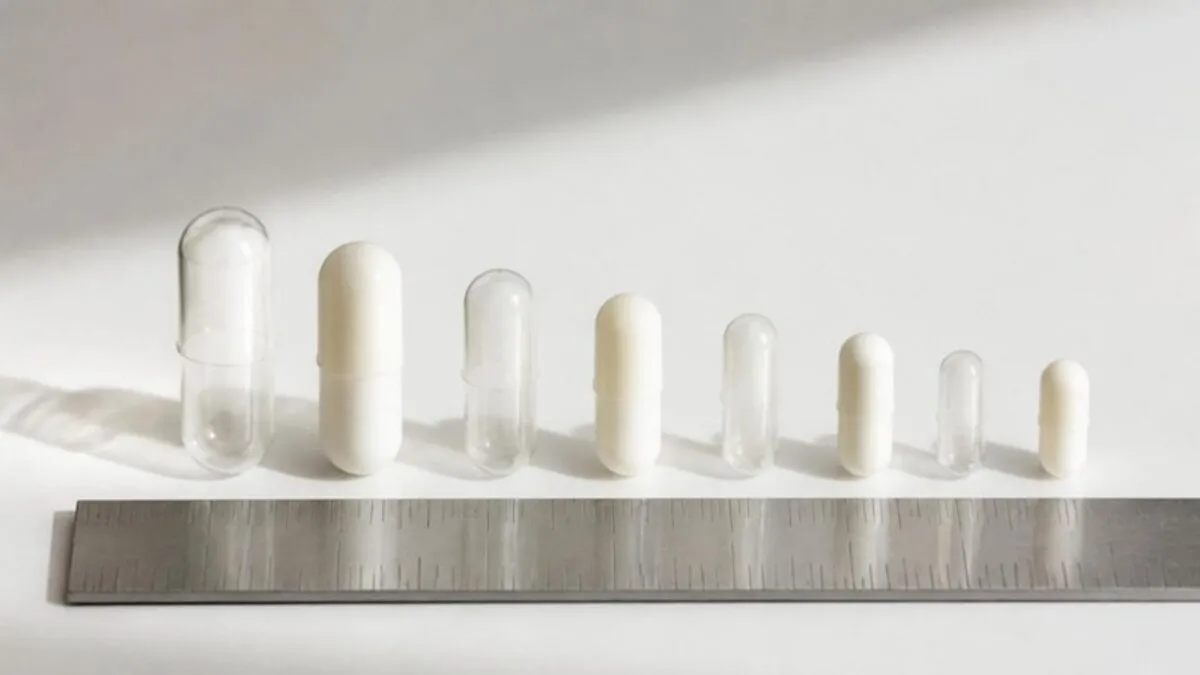
- Size and dose: size is set by fill weight and blend density — not by shell material. Use Zenith’s capsule size chart 000–4 for fill ranges and size 00 vs 0 decisions.
- Appearance and print: clear, coloured, opaque and printed shells are available; printed and custom-coloured programmes usually carry a higher minimum and longer lead time than stock clear.
- Supply terms: named warehouse city, carton MOQ, ship window and lot documents — not only a unit price.
Gelatin vs HPMC at a glance (buyer view)
| Factor | Gelatin (bovine / porcine) | HPMC (vegetarian) |
|---|---|---|
| Source | Animal collagen (bovine or porcine) | Plant-derived hydroxypropyl methylcellulose |
| Dietary / religious positioning | Not vegetarian; Kosher/Halal depend on certified source | Vegetarian / vegan-suitable; commonly used for clean-label and religious positioning |
| Typical shell moisture (Zenith programme) | Typically 13–16% | Typically 4–9% |
| Fill compatibility (practical) | Strong default for many dry, free-flowing fills where animal origin is acceptable | Often preferred for moisture-sensitive / hygroscopic fills |
| Machinability (practical) | Often runs faster on common filling equipment; familiar to most lines | Machine-compatible; trial recommended for high-speed changeovers |
| Cost-in-use framing | Usually the lower shell cost baseline when vegan claims are not required | Typically carries a material premium; can still win total cost when it prevents scrap, crosslinking risk or channel rejection |
| Crosslinking risk | Known failure mode under adverse heat/humidity storage that can slow dissolution | Does not cross-link the same way; often chosen for humid-market stability |
| Disintegration (Zenith typical) | ≤ 15 minutes typical on the published programme; the lot Certificate of Analysis governs | |
Zenith’s product FAQ states the same practical rule: gelatin often costs less and runs faster on most filling machines when an animal-derived shell is acceptable; HPMC fits vegetarian and clean-label positioning and tolerates hygroscopic fills better because of its lower moisture.
Moisture, stability and fill compatibility
Empty-capsule moisture is not a trivia line — it drives brittleness, stickiness and how the fill behaves in the bottle. On Zenith’s published empty-capsule programme, gelatin shells typically sit around 13–16% moisture and HPMC around 4–9%. Lower HPMC moisture is why many formulators move hygroscopic herbals, certain mineral forms and other moisture-sensitive actives into vegetable shells. Gelatin remains the workhorse when the fill is stable, animal origin is acceptable, and line speed or shell economics dominate.
Storage and ship conditions still matter for both materials. Ask every supplier for lot moisture on the COA, recommended storage RH, and whether the carton uses a food-grade liner. A cheaper shell that cracks or softens between the warehouse and the filler is not cheaper per usable thousand.
Sizes Zenith offers (and a programme note)
Zenith’s live empty-capsules product page lists standard sizes 000, 00, 0, 1, 2, 3 and 4 in bovine gelatin, porcine gelatin and vegetarian HPMC, in clear, coloured, opaque and printed formats. Size 00 and size 0 remain the most common wholesale starting points for supplements; Zenith’s published fill guide ranges are approximately 570–1100 mg for size 00 and 400–800 mg for size 0, both density-dependent.
Size-range note: Zenith’s empty-capsules product page and East Coast capsule stock Insight list sizes 000–4. Zenith’s contract-manufacturing empty-capsule supply copy currently lists sizes 00–4. Do not assume size 000 is available on every CM path without confirming on the quote. This Insight follows the product page for shell supply.
MOQ, carton quantities, lead time and East Coast stock
Zenith sells empty capsules by the carton with a 1-carton minimum. Carton piece count varies by capsule size and shell material; Zenith does not publish a public per-size count table — the exact count for your size and material is confirmed on the quote. Stock clear gelatin and HPMC lines typically ship in 3–7 business days from US stock in Ronkonkoma, Long Island, New York. Printed and custom-coloured shells usually need a higher minimum and a longer lead time than stock clear — raise colour and print at project start.
For East Coast brands and compounding pharmacies, named Ronkonkoma stock matters because national e-com carton programmes (often Florida or multi-state distribution) and import factory MOQs (sometimes from roughly a million pieces upward for stock colours) do not always match a mid-scale production calendar. See East Coast empty capsule stock — gelatin & HPMC from Ronkonkoma, NY for the logistics framing.
Cost-in-use without dollar figures
Public market commentary generally places HPMC shells at a premium to gelatin at the same size and order band. That premium is not automatically the wrong buy. Cost-in-use for empty capsules includes:
- Shell material cost at your real carton quantity (not a million-piece factory list)
- Scrap and downtime if moisture or machinability mis-matches the fill or the line
- Channel and label risk if a gelatin shell blocks a vegetarian, vegan or religious claim
- Freight and cash tied up when the MOQ forces you to overbuy
- Qualification cost when lot documents are incomplete
Compare delivered carton economics at the quantity you will actually fill this quarter, including documents and ship-from city — not only a per-thousand figure copied from an overseas listing. Zenith does not publish list prices; we quote against your size, material, print and destination.
Documents that should arrive with every carton lot
On Zenith’s published programme, every lot ships with a lot-specific Certificate of Analysis covering identity, moisture, disintegration and microbial limits, with full lot traceability back to the shell manufacturer. Buyers should also expect an SDS, technical/specification sheet, allergen/GMO (and gluten) statements, a BSE/TSE-free statement for gelatin, and Kosher or Halal certificates where those claims apply. Microbial expectations on the published programme align with USP <2021>/<2022>; disintegration is typically ≤ 15 minutes, with the lot COA governing.
Related Zenith capsule reading
- How to choose empty capsules for nutraceutical and pharma filling — practical checklist (gelatin vs HPMC, size by fill weight, print, COA).
- Capsule size chart 000–4 — fill weight, volume and size 00 vs 0 for wholesale buyers.
- East Coast empty capsule stock — Ronkonkoma carton MOQ and docs.
- Private-label beef organ capsules — shell choice inside a finished private-label path.
- Contract manufacturing RFQ checklist — when shells feed a Zenith CM run rather than shipping loose.
RFQ checklist before you order cartons
- Shell material: bovine gelatin / porcine gelatin / HPMC (vegetarian).
- Size: preferred size if known (product programme lists 000–4; confirm 000 if required) — or send target dose (mg) and tapped bulk density (g/mL).
- Format: clear vs coloured / opaque / printed (artwork timing if printed).
- Quantity: first-order cartons and expected reorder; ask for piece count per carton for that size.
- Path: shells ship loose to your filler, or into a Zenith contract manufacturing run.
- Ship window: stock clear vs printed / made-to-order; ship-to ZIP and dock needs.
- Documents: lot COA, SDS, spec sheet, allergen/GMO statements, BSE/TSE (gelatin), Kosher/Halal as applicable, supplier questionnaire.
- Sample: whether you need an evaluation quantity before the production carton.
Zenith Nutra Products holds empty gelatin and HPMC hard capsules as US stock in Ronkonkoma, Long Island, NY, with a 1-carton MOQ and 3–7 business-day dispatch on inventory-held clear lines. Request an empty-capsule quote or review the empty capsules product page for the full specification.